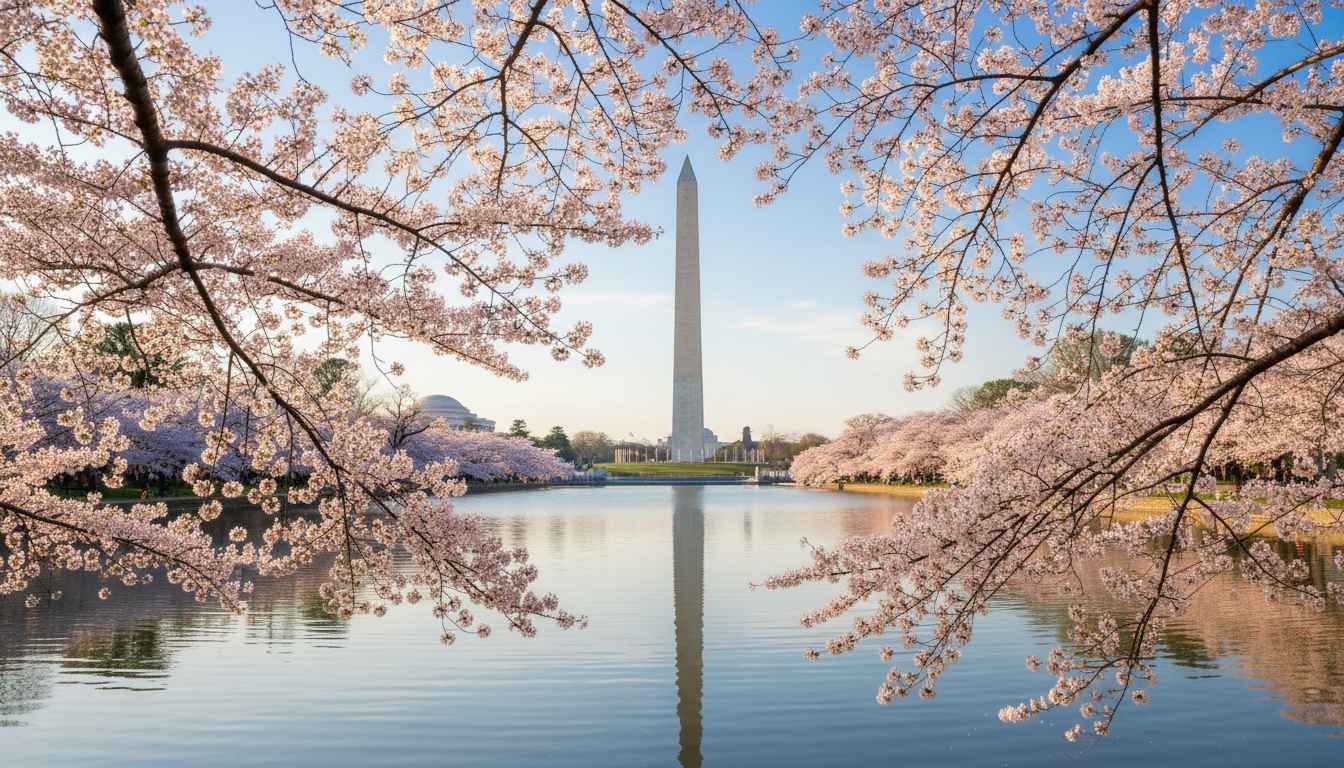
Picture yourself standing on the wide steps of the Lincoln Memorial just after sunrise, the Reflecting Pool stretching out in front of you and the Washington Monument rising at the far end. The city is still quiet, and for a few minutes it feels like you have the nation’s capital entirely to yourself. That is the moment Washington DC makes sense — not as a postcard, but as a place where history is something you walk through, block by block. From world-famous monuments to cobblestone streets and free museums, these are the best places to visit at Washington DC, and they make the capital one of the best places to visit in the US for a first trip.
The National Mall: Monuments and Memorials
Start where almost every DC trip begins: the National Mall. This two-mile stretch of green space runs from the U.S. Capitol to the Lincoln Memorial and packs in more landmarks per block than almost anywhere else in the country. Walk the full length at least once. You will pass the Washington Monument, the World War II Memorial with its fountains and state pillars, the Vietnam Veterans Memorial with its quietly powerful wall of names, and the Korean War Veterans Memorial nearby.
The Lincoln Memorial deserves unhurried time. Climb the steps, read the inscriptions of the Gettysburg Address and the Second Inaugural Address carved into the walls, and turn around for the view down the Mall toward the Capitol. Many visitors come at night, when the memorials are lit and the crowds thin out — it is one of the city’s most memorable after-dark experiences and completely free.
The Smithsonian Museums — All Free
One of the best things about visiting Washington DC is that its greatest museums cost nothing to enter. The Smithsonian Institution runs more than a dozen museums and galleries in the city, and admission to all of them is free. A few standouts for first-time visitors:
- National Museum of Natural History: dinosaurs, the Hope Diamond, and an ocean hall that can easily fill half a day.
- National Museum of American History: the original Star-Spangled Banner, presidential artifacts, and exhibits on American popular culture.
- National Air and Space Museum: the Wright Flyer, the Apollo 11 command module, and a planetarium — a favorite for families.
- National Gallery of Art: a world-class art collection split between the West Building and the modern East Building, with a sculpture garden between them.
Because entry is free, you can dip into several museums in one day without worrying about ticket prices. Go early: the most popular museums fill up fast, and some use free timed-entry passes, so check the museum’s own site before you go.
Capitol Hill and the Seat of Government
At the eastern end of the Mall sits the U.S. Capitol, the domed symbol of American democracy. Free guided tours of the Capitol run through the Capitol Visitor Center and are worth booking ahead. Right next door, the Library of Congress — the largest library in the world — is a destination in its own right: its main reading room and the Gutenberg Bible on display make it one of the most beautiful interiors in the city.
A short walk away you will find the Supreme Court, where you can attend lectures when the court is not in session, and the White House. You can view the White House from Pennsylvania Avenue and Lafayette Square; public tours inside require advance planning through a congressional office, so arrange them well before your trip if that is a priority.
Georgetown and the City’s Neighborhoods
DC is not just monuments — its neighborhoods are half the experience. Georgetown is the city’s oldest, with Federal-style rowhouses, cobblestone side streets, the shopping and dining of M Street, and a waterfront park along the Potomac that is perfect for an evening stroll. Walk the Chesapeake and Ohio Canal towpath to see a quieter, greener side of the neighborhood.
For food and nightlife, head to U Street — once known as Black Broadway, now packed with live-music venues and restaurants — or Adams Morgan and Dupont Circle for bars and international dining. On weekends, do not miss Eastern Market on Capitol Hill, where local vendors sell fresh produce, crafts, and art in a historic 19th-century market hall.
The Tidal Basin and Outdoor Escapes
The Tidal Basin is the scenic reservoir between the Mall and the Potomac, ringed by the cherry trees Japan gifted to the United States in 1912. In spring, usually late March to early April, the blossoms draw visitors from around the world — book accommodation early if you are coming for them. The walk around the basin also takes you past the Jefferson Memorial, the Franklin Delano Roosevelt Memorial, and the Martin Luther King, Jr. Memorial.
For more nature, Rock Creek Park cuts through the northwest of the city with miles of hiking and biking trails, picnic areas, and a planetarium at its nature center. It is the city’s best escape when you need a break from sightseeing.
Day Trips Worth Your Time
If you have an extra day, cross the Potomac into Virginia. Arlington National Cemetery is the resting place of more than 400,000 service members, and the Changing of the Guard at the Tomb of the Unknown Soldier is a moving ceremony to witness. Continue south to Old Town Alexandria, a beautifully preserved colonial port town with brick sidewalks, independent shops, and a lively waterfront — an easy half-day trip by Metro or water taxi.
Practical Tips for Visiting Washington DC
DC is one of the easiest American cities to visit without a car. The Metro connects the airport, the Mall, and most neighborhoods, and the central sights are genuinely walkable — expect to cover several miles a day on foot, so wear comfortable shoes. Spring and fall bring the most pleasant weather; summers are hot and humid, and winter is quiet but cold. Because so many headline attractions are free, DC is also kinder to travel budgets than most capitals — your biggest costs will be accommodation and food. If Washington is one stop on a longer journey, it fits naturally into a wider East Coast itinerary alongside cities like New York and Boston.
FAQs About Visiting Washington DC
How many days do you need in Washington DC?
Three full days cover the essentials: one day for the National Mall and memorials, one for the Smithsonian museums, and one for Capitol Hill plus a neighborhood like Georgetown. Add a fourth day for Arlington, Alexandria, or a deeper museum dive.
What is the best time of year to visit Washington DC?
Spring (March to May) and fall (September to November) offer the most comfortable weather. Spring brings the famous cherry blossoms; fall brings smaller crowds and crisp walking weather. Summer is peak season but hot and humid.
Are the Smithsonian museums really free?
Yes. All Smithsonian museums and the National Zoo offer free admission every day. Some popular exhibits or museums may use free timed-entry passes during busy periods, so check ahead.
Is Washington DC walkable?
The monumental core — the Mall, Tidal Basin, Capitol Hill, and the White House area — is very walkable. For neighborhoods farther out, the Metro is clean, safe, and easy to use.
Final Thoughts
Washington DC rewards travelers who slow down. Yes, the monuments and museums are the headline acts, and they live up to their reputation — but the city’s real charm shows in the details: a jazz club on U Street, morning light on the Tidal Basin, the hush inside the Lincoln Memorial. Plan around the free attractions, walk as much as you can, and leave room in your schedule for the unexpected. Few American cities pack this much history, culture, and green space into one walkable package, which is exactly why it belongs on every traveler’s list of the best places to visit at Washington DC and beyond.